Sony wildlife lens guide
Best Sony E-Mount Lenses for Wildlife
Sony E-mount has a deep used telephoto market for wildlife and bird photography. This guide compares current native inventory using meaningful telephoto reach, wildlife-use data, autofocus indicators, price and condition availability.
Editorial verdict
The best lens depends on the camera and the job.
Sony FE 200-600mm f/5.6-6.3 G OSS Full-Frame Autofocus Lens is the current best wildlife fit recommendation. That does not make it the automatic choice for every Sony E photographer. Photographers with different focal-length, sensor-format or focusing needs should compare it directly with Sony E 55-210mm f/4.5-6.3 OSS Autofocus APS-C Lens.
Price and inventory depth support these recommendations, but neither replaces compatibility, focal-length fit or practical shooting needs.
Who this guide is for
For Sony E-mount photographers choosing a native telephoto lens for birds, wildlife and other distant subjects.
How products were selected
The dedicated wildlife selection requires native E-mount compatibility, active used inventory and at least 200mm of cataloged reach. Wildlife-use scoring, autofocus indicators, price and offer depth rank qualifying choices.
Quick comparison
Start with the trade-offs, not the ranking.
Eliminate products that do not match your sensor format, focus requirements or preferred focal length before comparing price.
| Recommendation | Category | Format | Focus | Lens type | Current price | Main compromise |
|---|---|---|---|---|---|---|
| Sony FE 200-600mm f/5.6-6.3 G OSS Full-Frame Autofocus Lens | Best wildlife fit | Full Frame | Autofocus | 200–600mm zoom | $1,695 | Modest maximum aperture for low-light work |
| Sony E 55-210mm f/4.5-6.3 OSS Autofocus APS-C Lens | Best affordable telephoto | APS-C | Autofocus | 55–210mm zoom | $128 | Designed primarily for crop-sensor bodies |
| Sony E 18-200mm f/3.5-6.3 OSS Autofocus APS-C Lens | Best travel crossover | APS-C | Autofocus | 18–200mm zoom | $303 | Designed primarily for crop-sensor bodies |
| Sigma 200mm f/2 DG OS S (Sports) Full-Frame Autofocus Lens | Best low-light crossover | Full Frame | Autofocus | 200mm prime | $2,863 | Fixed focal length reduces framing flexibility |
| Sony E 18-200mm f/3.5-6.3 PZ OSS Autofocus APS-C Lens | Best landscape crossover | APS-C | Autofocus | 18–200mm zoom | $463 | Designed primarily for crop-sensor bodies |
Detailed recommendations
Why each lens belongs here—and when it does not.
These are buyer profiles rather than a generic best-to-worst ranking.

Best wildlife fit
Sony FE 200-600mm f/5.6-6.3 G OSS Full-Frame Autofocus Lens
Sony FE 200-600mm f/5.6-6.3 G OSS Full-Frame Autofocus E-Mount Lens earns the best wildlife fit position because it currently combines 200–600mm zoom, Full Frame coverage and 9 active used offers.
Its most practical role is wildlife, sports and distant subjects where telephoto reach matters. The catalog identifies a maximum aperture of f/5.6-6.3 and autofocus operation. Prioritizes wildlife-use scoring among native lenses with at least 200mm of reach.
This is a recommendation for a particular type of photographer rather than a universal winner. Consider it for distant wildlife or sport when reach is the limiting factor; balance the narrow field of view against weight, shutter speed and support needs. It is less suitable for travel or everyday scenes where nearby subjects demand a wider view.
Buy this when
Consider it for distant wildlife or sport when reach is the limiting factor; balance the narrow field of view against weight, shutter speed and support needs.
Skip this when
It is less suitable for travel or everyday scenes where nearby subjects demand a wider view.
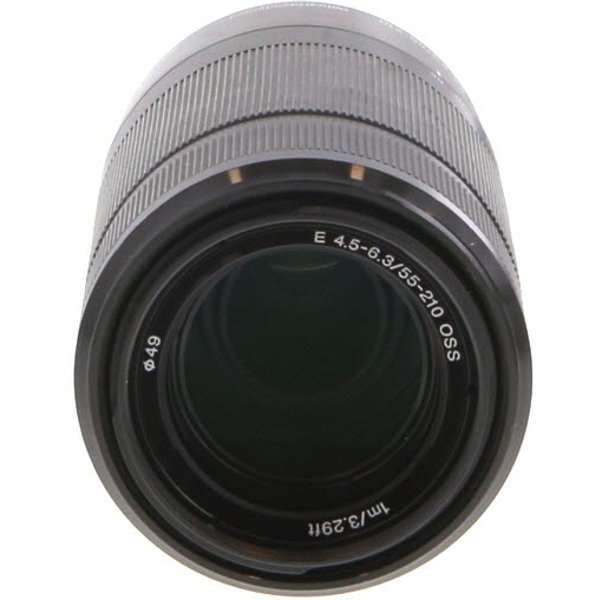
Best affordable telephoto
Sony E 55-210mm f/4.5-6.3 OSS Autofocus APS-C Lens
Sony E 55-210mm f/4.5-6.3 OSS Autofocus APS-C Lens for E-Mount earns the best affordable telephoto position because it currently combines 55–210mm zoom, APS-C coverage and 6 active used offers.
Its most practical role is everyday photography within its stated focal-length range. The catalog identifies a maximum aperture of f/4.5-6.3 and autofocus operation. Provides a lower-cost native route into longer focal lengths.
This is a recommendation for a particular type of photographer rather than a universal winner. Consider it when its focal range, sensor coverage and focusing method match a specific shooting need rather than simply because a used copy is available. Full-frame owners should verify image-circle coverage and whether crop mode is acceptable before buying.
Buy this when
Consider it when its focal range, sensor coverage and focusing method match a specific shooting need rather than simply because a used copy is available.
Skip this when
Full-frame owners should verify image-circle coverage and whether crop mode is acceptable before buying.

Best travel crossover
Sony E 18-200mm f/3.5-6.3 OSS Autofocus APS-C Lens
Sony E 18-200mm f/3.5-6.3 OSS Autofocus APS-C Lens for E-Mount earns the best travel crossover position because it currently combines 18–200mm zoom, APS-C coverage and 3 active used offers.
Its most practical role is general-purpose photography where flexible framing matters more than maximum aperture. The catalog identifies a maximum aperture of f/3.5-6.3 and autofocus operation. Looks for a distinct lens that also scores well for travel photography.
This is a recommendation for a particular type of photographer rather than a universal winner. Consider it as a general-purpose travel zoom if its wide end and long end match how you frame most pictures; compare the maximum aperture at the focal lengths you actually use. Full-frame owners should verify image-circle coverage and whether crop mode is acceptable before buying.
Buy this when
Consider it as a general-purpose travel zoom if its wide end and long end match how you frame most pictures; compare the maximum aperture at the focal lengths you actually use.
Skip this when
Full-frame owners should verify image-circle coverage and whether crop mode is acceptable before buying.

Best low-light crossover
Sigma 200mm f/2 DG OS S (Sports) Full-Frame Autofocus Lens
Sigma 200mm f/2 DG OS S (Sports) Full-Frame Autofocus Lens for Sony E-Mount earns the best low-light crossover position because it currently combines 200mm prime, Full Frame coverage and 2 active used offers.
Its most practical role is wildlife, sports and distant subjects where telephoto reach matters. The catalog identifies a maximum aperture of f/2 and autofocus operation. Prioritizes available-light usefulness in a different role within the kit.
This is a recommendation for a particular type of photographer rather than a universal winner. Consider it for available-light scenes and subject separation when you can compose by moving rather than zooming; verify the camera-format coverage first. It is less suitable for travel or everyday scenes where nearby subjects demand a wider view.
Buy this when
Consider it for available-light scenes and subject separation when you can compose by moving rather than zooming; verify the camera-format coverage first.
Skip this when
It is less suitable for travel or everyday scenes where nearby subjects demand a wider view.

Best landscape crossover
Sony E 18-200mm f/3.5-6.3 PZ OSS Autofocus APS-C Lens
Sony E 18-200mm f/3.5-6.3 PZ OSS Autofocus APS-C Lens for E-Mount earns the best landscape crossover position because it currently combines 18–200mm zoom, APS-C coverage and 4 active used offers.
Its most practical role is general-purpose photography where flexible framing matters more than maximum aperture. The catalog identifies a maximum aperture of f/3.5-6.3 and autofocus operation. Adds a lens useful for landscape work while keeping the shortlist varied.
This is a recommendation for a particular type of photographer rather than a universal winner. Consider it as a general-purpose travel zoom if its wide end and long end match how you frame most pictures; compare the maximum aperture at the focal lengths you actually use. Full-frame owners should verify image-circle coverage and whether crop mode is acceptable before buying.
Buy this when
Consider it as a general-purpose travel zoom if its wide end and long end match how you frame most pictures; compare the maximum aperture at the focal lengths you actually use.
Skip this when
Full-frame owners should verify image-circle coverage and whether crop mode is acceptable before buying.
Choose by priority
Match the lens to the job.
Best wildlife fit
Sony FE 200-600mm f/5.6-6.3 G OSS Full-Frame Autofocus Lens
Consider it for distant wildlife or sport when reach is the limiting factor; balance the narrow field of view against weight, shutter speed and support needs.
Read the full analysis →Best affordable telephoto
Sony E 55-210mm f/4.5-6.3 OSS Autofocus APS-C Lens
Consider it when its focal range, sensor coverage and focusing method match a specific shooting need rather than simply because a used copy is available.
Read the full analysis →Best travel crossover
Sony E 18-200mm f/3.5-6.3 OSS Autofocus APS-C Lens
Consider it as a general-purpose travel zoom if its wide end and long end match how you frame most pictures; compare the maximum aperture at the focal lengths you actually use.
Read the full analysis →Best low-light crossover
Sigma 200mm f/2 DG OS S (Sports) Full-Frame Autofocus Lens
Consider it for available-light scenes and subject separation when you can compose by moving rather than zooming; verify the camera-format coverage first.
Read the full analysis →Best landscape crossover
Sony E 18-200mm f/3.5-6.3 PZ OSS Autofocus APS-C Lens
Consider it as a general-purpose travel zoom if its wide end and long end match how you frame most pictures; compare the maximum aperture at the focal lengths you actually use.
Read the full analysis →Frequently asked questions
Buying used Sony E lenses.
How much reach is useful for Sony wildlife photography?
There is no single minimum for every subject, but longer focal lengths are commonly useful when subjects are small or cannot be approached. The dedicated wildlife selection here requires at least 200mm of reach.
Can full-frame Sony wildlife lenses be used on APS-C E-mount cameras?
Yes. Native FE lenses generally work on Sony APS-C E-mount bodies, where the smaller sensor produces a narrower field of view.
Should I choose reach or aperture first?
Start with subject distance and framing. Once the needed focal range is clear, compare aperture, autofocus, stabilization, size and used price.