Head-to-head · used lens buying intelligence
Canon RF 100–400mm vs RF 100–500mm L: Which Is Worth Buying Used?
These native full-frame Canon RF telephoto zooms begin at 100mm but suit different budgets and working habits. One is a relatively accessible and lightweight way into wildlife photography; the other reaches 500mm with L-series construction and additional handling features. The extra 100mm can matter for small distant birds, but its value depends on where and how you photograph—not simply which model is the more expensive lens.
Editorial research, not a claim of hands-on laboratory tests. We may earn a commission from qualifying retailer purchases at no extra cost to you.Which lens should you choose?
Choose the RF 100–400mm if you want a manageable first wildlife kit and usually photograph in good light. Consider the RF 100–500mm L when 400mm repeatedly leaves you cropping distant subjects, your budget allows a substantial premium, and the larger lens suits your carrying style.
The practical choice for wildlife beginners, long hikes and buyers who can work within a 400mm long end.
The longer-reaching alternative for distant birds and photographers who value premium handling enough to carry and pay for it.
Specifications that change the decision
Comparison at a glance
The specifications come from manufacturer documentation. They are provided for purchase decisions, not as invented sharpness, autofocus-speed or durability test scores.
| Consideration | Canon RF 100–400mm f/5.6–8 IS USM | Canon RF 100–500mm f/4.5–7.1 L IS USM | What it means |
|---|---|---|---|
| Native mount and format | Full-frame Canon RF | Full-frame Canon RF | Both can be used with compatible EOS R7 APS-C and EOS R8 full-frame bodies. |
| Focal range | 100–400mm | 100–500mm | The L zoom extends 25% farther at its long end; both begin at 100mm. |
| Maximum aperture | f/5.6–8 | f/4.5–7.1 | Both slow toward their long ends; neither is a constant-aperture zoom. |
| Manufacturer listed weight | Approximately 635g | Approximately 1,365g (without tripod mount) | The 100–400mm is substantially easier to carry on long walks. |
| Stabilization | Canon optical IS | Canon optical IS with selectable modes | IS helps with camera movement, but fast subjects still need suitable shutter speeds. |
| Extender consideration | Compatible RF extenders listed by Canon | RF extender operation limited to the 300–500mm zoom range | Confirm extender restrictions and effective aperture before budgeting for additional reach. |
Purchasing options · verified when available
Compare current used listings
Prices below apply to the specific eligible retailer offers, not every grade or copy of the lens. KEH prices are withheld if their independently monitored feed is stale; eBay listings must meet the recent-refresh requirement. Confirm shipping, returns, accessories and final stock with the merchant.
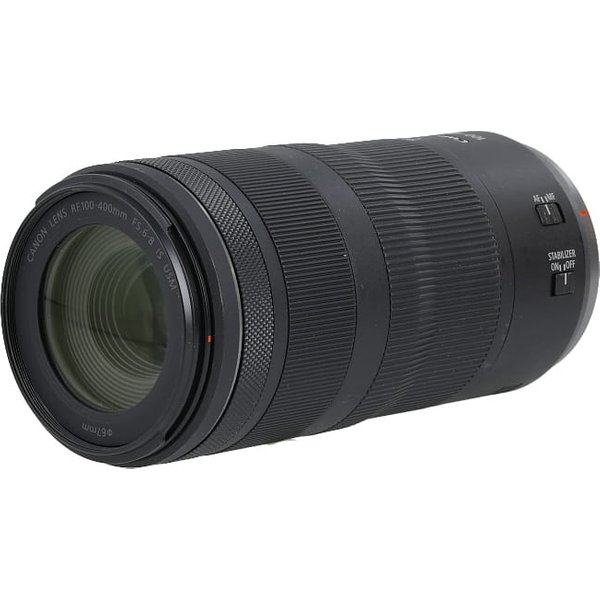
Canon RF 100-400mm f/5.6-8 IS USM Full-Frame Lens
Currently eligible used purchasing options

Canon RF 100-500mm f/4.5-7.1 L IS USM Full-Frame Lens
Currently eligible used purchasing options
Lowest tracked KEH offers: Canon RF 100–400mm f/5.6–8 IS USM: $675 (Excellent); Canon RF 100–500mm f/4.5–7.1 L IS USM: $2,738 (Excellent). The listed-price difference is $2,063, but these may be different condition grades or include different accessories. It is not a like-for-like quality-adjusted saving. Check individual listing details and total checkout costs.
Editorial purchase analysis
Where the differences matter
Does 500mm actually improve your wildlife photographs?
From the same shooting position, 500mm gives a tighter field of view than 400mm. That difference is useful when a small bird would otherwise need significant cropping. It will not overcome atmospheric haze, weak light or inaccurate focusing. The narrower view can also make it harder to reacquire a fast-moving bird if it disappears from the frame.
On an APS-C EOS R7, both lenses frame more tightly than on an EOS R8 because of sensor size. Crop factor does not physically lengthen a lens or change its maximum aperture. For larger wildlife at moderate distances, the less expensive RF 100–400mm may already give the composition you need.
The aperture and weight trade-off
The RF 100–400mm has a variable maximum aperture, reaching f/8 at 400mm. The L-series zoom is specified as f/4.5–7.1 across its range, and reaches f/7.1 at its long end. In dim light, either may require elevated ISO or a different shooting strategy to maintain a fast enough shutter speed for moving subjects. Optical stabilization is not a substitute for freezing animal movement.
Canon lists the smaller zoom at around 635g, versus approximately 1,365g for the 100–500mm without its tripod mount. This is consequential when walking all day or tracking overhead birds for several minutes. L-series build and handling controls are meaningful, but should be weighed against whether you will actually bring the heavier lens.
Which used copy represents the better deal?
Inspect autofocus, optical IS, glass clarity, mounting surfaces and smooth zoom operation. Seller listings for the 100–500mm may differ in whether they include the tripod-foot accessory and hood, so compare the entire kit rather than assuming every advertised unit has identical contents. Confirm the smaller lens's included hood and caps too.
KEH condition grades and eBay seller descriptions are separate systems. The starting prices displayed here refer to individual currently eligible listings, not a guarantee that every grade remains available. Inspect shipping, return terms and the exact checkout total before choosing a seller.
Before you pay
Used-lens inspection checklist
- Confirm RF mount, exact model and image coverage.
- Review glass for haze/fungus and inspect AF, IS and zoom-ring function.
- Check whether the 100–500mm listing includes its tripod-foot accessory and hood.
- Compare total condition-adjusted cost, returns and shipping.
The exact model, optical condition, accessories, grade, warranty and seller return terms matter more than a small headline price difference. Read our complete used-lens buying guide.
Sources, methodology and verification
Mirrorless Lens World Editorial Desk reviewed this comparison on October 3, 2026, using the manufacturer documentation below and the site's native product-family catalog. Retailer data is refreshed separately. No original bench measurements or personal handling tests are claimed.
- Canon RF 100–400mm manufacturer support and specifications ↗
- Canon RF 100–500mm L manufacturer specifications ↗
See our editorial policy and affiliate disclosure.
Frequently asked buying questions
Can either lens work on Canon EOS R7?
Yes. Both are native full-frame RF lenses that can cover the R7 APS-C sensor. The smaller sensor changes framing relative to full-frame RF bodies, not physical focal length.
Is the RF 100–500mm dramatically brighter than the 100–400mm?
Their maximum apertures differ, but both are variable. The RF 100–500mm reaches f/7.1 at its long end, while the RF 100–400mm reaches f/8 at 400mm.
Does the Canon RF 100–500mm take a teleconverter at every zoom position?
No. Canon specifies RF extender compatibility only within its 300–500mm zoom range.