Head-to-head · used lens buying intelligence
Fujifilm XF 10–24mm WR vs Original OIS: Which Used Version Should You Buy?
Fujifilm's two XF 10–24mm f/4 ultra-wide zoom generations can look confusingly similar in used listings. Both cover the same 10–24mm APS-C X-mount range at constant f/4, and Fujifilm says the later WR version retains the earlier optical design. The decision is therefore mainly about weather resistance, updated stabilization and handling controls—and the premium asked for a specific used copy.
Editorial research, not a claim of hands-on laboratory tests. We may earn a commission from qualifying retailer purchases at no extra cost to you.Which lens should you choose?
Choose the XF 10–24mm OIS WR if you photograph outdoors in unsettled weather, value its marked aperture ring and improved stabilization, or if the used price premium is modest after condition and accessories are considered. The original OIS version can offer better value for controlled-condition architecture and landscape work when it is substantially cheaper and in reliable condition.
Outdoor X-system photographers who value WR construction, updated stabilization and aperture-ring controls.
Budget-sensitive landscape and interiors users who mostly shoot in controlled conditions and can find a well-kept original copy.
Specifications that change the decision
Comparison at a glance
The specifications come from manufacturer documentation. They are provided for purchase decisions, not as invented sharpness, autofocus-speed or durability test scores.
| Consideration | Fujifilm XF 10–24mm f/4 R OIS WR | Fujifilm XF 10–24mm f/4 R OIS (original) | What it means |
|---|---|---|---|
| Mount / coverage | Fujifilm X / APS-C | Fujifilm X / APS-C | Both are native X-mount lenses; neither is GF/GFX mount. |
| Focal range / maximum aperture | 10–24mm, constant f/4 | 10–24mm, constant f/4 | The fundamental framing range and maximum aperture do not change. |
| Weather-resistant designation | WR construction | No WR designation | The newer version is preferable when weather protection is a meaningful use case. |
| Optical stabilization | Manufacturer rating 3.5 stops | Prior generation approximately one stop lower | The newer version improves manufacturer-rated shake correction; results depend on shooting technique and camera. |
| Aperture controls | Marked f-stop scale and A-position lock | Original aperture-ring design | The WR version gives additional tactile feedback and an A-position lock. |
| Manufacturer weight | Approximately 385g | Approximately 410g | The WR design is about 25g lighter. |
Purchasing options · verified when available
Compare current used listings
Prices below apply to the specific eligible retailer offers, not every grade or copy of the lens. KEH prices are withheld if their independently monitored feed is stale; eBay listings must meet the recent-refresh requirement. Confirm shipping, returns, accessories and final stock with the merchant.

Fujifilm XF 10-24mm f/4 R OIS WR Fujinon Lens for APS-C Format X-Mount
Currently eligible used purchasing options
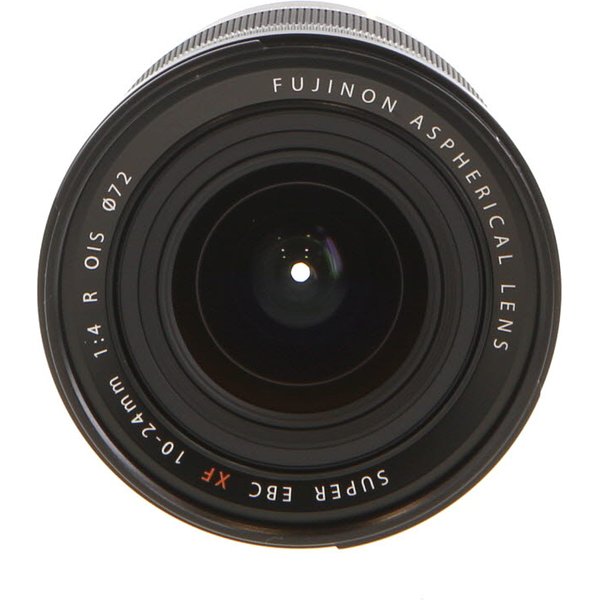
Fujifilm XF 10-24mm f/4 R OIS Fujinon Lens for APS-C Format X-Mount
Currently eligible used purchasing options
Lowest tracked KEH offers: Fujifilm XF 10–24mm f/4 R OIS WR: $584 (Bargain); Fujifilm XF 10–24mm f/4 R OIS (original): $328 (Bargain). The listed-price difference is $256, but these may be different condition grades or include different accessories. It is not a like-for-like quality-adjusted saving. Check individual listing details and total checkout costs.
Editorial purchase analysis
Where the differences matter
Do not confuse a new exterior with a new optical formula
Fujifilm states that the WR revision carries forward the original XF 10–24mm optical design. Both therefore preserve the same very wide 10mm starting point, 24mm long end and constant f/4 aperture. A more expensive WR copy should not be sold to readers as inherently sharper simply because it is newer.
At 10mm, converging verticals and exaggerated near-to-far relationships can matter more than small differences between copies. For interiors and architecture, careful leveling and composition are necessary with either generation.
Weather sealing and stabilization may justify the price difference
The 2020 WR update added weather-resistant construction, an aperture-ring scale and an A-position lock. Fujifilm also describes stabilization improved by one stop to a rated 3.5 stops, plus a slightly lighter body. Weather resistant does not mean waterproof, and stabilization helps camera shake rather than freezing moving people.
For a controlled indoor architecture assignment with a tripod, those improvements may be less valuable than a well-priced original lens. Landscape photographers who work near rain, sea spray or cold mountain conditions may reasonably prefer the WR design, while still caring for the lens and camera body appropriately.
Verify generation and used condition before paying
Check the printed model designation on the barrel and seller images. The WR lens should be explicitly identified as XF10–24mmF4 R OIS WR; an original OIS listing is not automatically the same product. The exact hood, caps and cosmetic/optical grade should be reviewed separately.
Compare autofocus, stabilization, zoom-ring movement and glass condition. A higher-grade original may be the more sensible purchase than a damaged WR copy. Current KEH and eBay offers below are conditional buying leads, not promises of merchant stock or final checkout prices.
Before you pay
Used-lens inspection checklist
- Check the full model name: OIS WR versus the earlier OIS without WR.
- Inspect front/rear elements, focus, zoom, OIS operation and barrel condition.
- Check hood, caps, condition grading and the seller's exact photographs.
- Compare the full delivered price, return terms and whether the WR features matter for your actual workflow.
The exact model, optical condition, accessories, grade, warranty and seller return terms matter more than a small headline price difference. Read our complete used-lens buying guide.
Sources, methodology and verification
Mirrorless Lens World Editorial Desk reviewed this comparison on October 14, 2026, using the manufacturer documentation below and the site's native product-family catalog. Retailer data is refreshed separately. No original bench measurements or personal handling tests are claimed.
- Fujifilm 2020 announcement comparing the original and WR revision ↗
- Fujifilm XF 10–24mm WR official specifications ↗
See our editorial policy and affiliate disclosure.
Frequently asked buying questions
Does the WR version have a different focal range?
No. Both cover 10–24mm with a constant f/4 maximum aperture for Fujifilm X APS-C cameras.
Is the newer WR version optically sharper?
Fujifilm states that it retains the earlier optical design. Do not assume better optical resolution solely from the WR name.
Which one is weather resistant?
The later XF 10–24mm f/4 R OIS WR has a WR construction designation; the original XF 10–24mm f/4 R OIS does not.