Head-to-head · used lens buying intelligence
Nikon Z9: 70–180mm f/2.8 vs 70–200mm f/2.8 VR S — Used Telephoto Value
Nikon Z9 owners considering a fast portrait and event telephoto often face a choice between Nikon's comparatively compact 70–180mm f/2.8 and the professional 70–200mm f/2.8 VR S. Both maintain f/2.8 throughout their ranges and cover the Z9's FX sensor. The professional lens extends another 20mm, includes optical VR and provides a different handling package, but it is substantially heavier. Comparing their price tags without considering assignment length, light, accessories and whether the extra reach is useful can lead to an expensive mistake. This comparison addresses the original VR S rather than a later VR S II model.
Editorial research, not a claim of hands-on laboratory tests. We may earn a commission from qualifying retailer purchases at no extra cost to you.Which lens should you choose?
Choose the 70–180mm f/2.8 for portrait, travel and event use when weight and carrying freedom matter more than built-in lens VR and the last 20mm. Choose the original 70–200mm f/2.8 VR S when the professional handling, dedicated VR and additional reach justify its greater weight and higher total used cost. For distant birds, neither is a long wildlife zoom.
Portable portraits, weddings and general-event telephoto work with a constant f/2.8 aperture.
Professional assignments that prioritize in-lens VR, robust controls and 200mm framing over lighter carry weight.
Specifications that change the decision
Comparison at a glance
The specifications come from manufacturer documentation. They are provided for purchase decisions, not as invented sharpness, autofocus-speed or durability test scores.
| Consideration | NIKKOR Z 70–180mm f/2.8 | NIKKOR Z 70–200mm f/2.8 VR S | What it means |
|---|---|---|---|
| Mount / sensor | Nikon Z FX full frame | Nikon Z FX full frame | Both cover the full sensor of the Nikon Z9. |
| Focal range | 70–180mm | 70–200mm | The VR S gives about 11% more reach at the long end, not an entirely different class of telephoto. |
| Maximum aperture | Constant f/2.8 | Constant f/2.8 | No inherent exposure-speed advantage at the same focal length. |
| Manufacturer weight | 795g | Approximately 1,360g with tripod collar | The 70–180mm is roughly 565g lighter according to Nikon's published comparison. |
| Optical lens VR | No built-in optical VR | Built-in VR | Body stabilization can help either; VR may improve handheld stability, but cannot stop a moving subject. |
| Filter diameter | 67mm | 77mm | Existing filter sets may favor one lens. |
| Close-focus capability | 0.27m at 70mm; maximum 0.48× | Different close-focus specifications by zoom position | The lighter 70–180mm has useful close-up capability but does not replace a dedicated macro. |
| Generation identification | NIKKOR Z 70–180mm f/2.8 | NIKKOR Z 70–200mm f/2.8 VR S (original) | Do not mix VR S II pricing or different adapters and lens versions into the same comparison. |
Purchasing options · verified when available
Compare current used listings
Prices below apply to the specific eligible retailer offers, not every grade or copy of the lens. KEH prices are withheld if their independently monitored feed is stale; eBay listings must meet the recent-refresh requirement. MPB US offers come from its Partnerize product feed; condition grade must be confirmed at MPB. Confirm shipping, returns, accessories and final stock with the merchant.
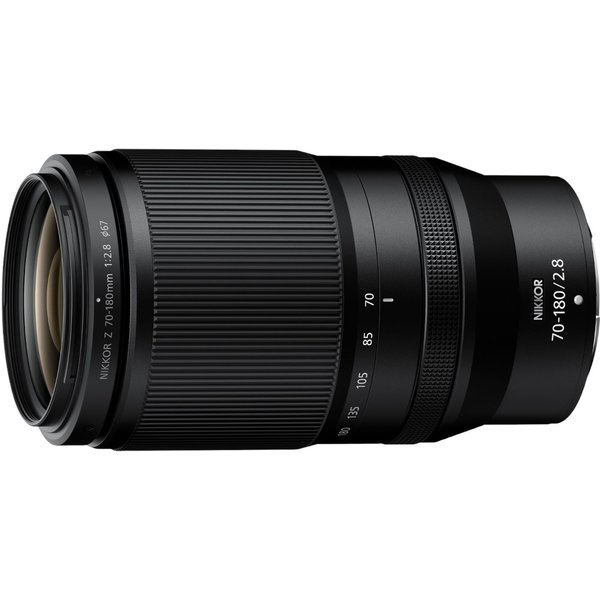
Nikon Nikkor Z 70-180mm f/2.8 Autofocus FX Lens
Currently eligible used purchasing options

Nikon Nikkor Z 70-200mm f/2.8 VR S Autofocus FX Lens
Currently eligible used purchasing options
Lowest tracked KEH offers: NIKKOR Z 70–180mm f/2.8: $1,078 (Excellent); NIKKOR Z 70–200mm f/2.8 VR S: $1,729 (Excellent). The listed-price difference is $651, but these may be different condition grades or include different accessories. It is not a like-for-like quality-adjusted saving. Check individual listing details and total checkout costs.
Editorial purchase analysis
Where the differences matter
What does the final 20mm actually buy?
A 200mm focal length frames a distant subject somewhat tighter than 180mm from the same viewpoint, but the difference is much smaller than switching from a standard zoom to a 400mm wildlife lens. A portrait or ceremony photographer may value 200mm to isolate faces without moving forward; a travel photographer could often crop the Z9's high-resolution image slightly and be content with 180mm.
Both lenses share a constant f/2.8 maximum aperture. That makes each suitable for the same exposure decisions at matching focal lengths; upgrading to the larger model does not automatically provide a faster shutter speed in poor light. The deciding factors are reach, balance, stabilization behavior, handling features and used-price spread.
Why 565 grams and stabilization both matter
Nikon lists the 70–180mm at approximately 795g and compares it with the original 70–200mm VR S at roughly 565g more. That difference is noticeable on the already heavy Z9, especially when handholding through a wedding or walking between portrait locations. Reducing lens weight can also allow a smaller support system or more comfortable bag.
The professional 70–200mm has optical VR, while the 70–180mm does not. The Z9 has in-body stabilization, but the interaction between body and lens settings should be evaluated for the precise shooting mode. VR helps suppress camera movement, not the travel of a running athlete or dancer across the frame. At fast action shutter speeds, additional in-lens stabilization may be less important than reliable focusing and subject tracking.
Separate useful features from paying for a badge
A used 70–200mm VR S may include a tripod collar and dedicated hood that affect carrying and replacement cost. Check exactly which accessories are supplied. Inspect focus action, zoom mechanics, glass, impact marks, the lens controls and stabilizer operation. The 70–180mm can appeal to those who want f/2.8 without committing to the larger kit, but a cheap copy with worn mount contacts or damaged zoom mechanics is poor value.
Make certain the seller is offering the original VR S rather than a newer VR S II, and never compare apparently identical prices across different condition grades. The Z9's full-frame resolution rewards precise focus, yet specification tables cannot establish which individual used sample is optically centered. Confirm return terms and take test photographs if possible.
Before you pay
Used-lens inspection checklist
- Distinguish Nikon Z 70–180mm f/2.8 from the original NIKKOR Z 70–200mm f/2.8 VR S and any S II listing.
- Check glass, zoom and focus smoothness, mount contacts, VR on the larger lens and body compatibility.
- Confirm supplied tripod collar, hood, caps, case and filter size where applicable.
- Calculate the price and weight premium for a modest 20mm of additional reach and in-lens stabilization.
The exact model, optical condition, accessories, grade, warranty and seller return terms matter more than a small headline price difference. Read our complete used-lens buying guide.
Sources, methodology and verification
Mirrorless Lens World Editorial Desk reviewed this comparison on November 3, 2026, using the manufacturer documentation below and the site's native product-family catalog. Retailer data is refreshed separately. No original bench measurements or personal handling tests are claimed.
- Nikon NIKKOR Z 70–180mm f/2.8 official technical data ↗
- Nikon analysis of 70–180mm portability versus 70–200mm VR S ↗
See our editorial policy and affiliate disclosure.
Frequently asked buying questions
Does the lighter Nikon zoom lose a stop of light?
No. Both maintain f/2.8 throughout the zoom range, giving comparable maximum-aperture exposure at matched focal lengths.
Is 200mm much longer than 180mm?
It offers about 11% more focal length at the long end. The framing difference is real but relatively modest.
Does the 70–180mm have optical VR?
Nikon does not list in-lens VR for the 70–180mm. A Z9 supplies in-body stabilization, which addresses camera shake rather than subject motion.