Sony E camera guide
Best lenses for Sony a6500 in 2026
The Sony a6500 is a 24.2-megapixel APS-C E-mount mirrorless camera with five-axis sensor-shift stabilization and 425 phase-detection autofocus points. Its relatively compact body is appealing for travel, documentary work and photography with smaller lenses, but it is an older camera generation. The strongest lens upgrades depend on which limitation you actually face: a fast normal prime for indoor people, an ultra-wide for cramped spaces, a macro for small subjects or a telephoto for outdoor action. The camera can mount both APS-C E lenses and full-frame FE lenses; full-frame coverage does not change the a6500’s approximately 1.5x crop factor.
Start shopping with compatibility confirmed
Find a lens for your Sony a6500
Choose how you shoot to see a prioritized, native-mount shortlist with available retailer offers. The Finder retains this camera selection.
Building the kit
Add capabilities, not duplicate focal lengths.
For a small all-purpose kit, start with a stabilized 16–50mm or other compact APS-C standard zoom if your work moves between travel, groups and daily scenes. Add a Sony E 35mm f/1.8 OSS for stabilized normal-view people photography, or compare the Sigma 30mm f/1.4 DC DN when a wider aperture matters more than lens stabilization. A Sony E 30mm f/3.5 Macro addresses 1:1 detail reproduction rather than low-light portraits. Before buying a third lens, review whether a telephoto or a wider angle solves more failed photographs. Sony’s five-axis IBIS may help handholding, but it cannot stop moving subjects.
Compatibility
Sony E is the native mount for the a6500. Sony APS-C E lenses and full-frame Sony FE lenses fit without a mount adapter, but any focal length has roughly 1.5x narrower full-frame-equivalent framing on this APS-C body. Confirm the exact mount when third-party lenses share a name across Sony E, Fujifilm X, Nikon Z or Micro Four Thirds versions. Some inexpensive manual lenses lack electronic communication and autofocus. Stabilization coordination, camera firmware and autofocus performance should be checked for each lens-body combination.
Independent research and buying comparison
Which lens is right for the Sony a6500?
The a6500 already has in-body stabilization and an APS-C sensor, so lens selection should solve an actual framing or exposure problem. A single normal prime cannot also be an ultra-wide, wildlife telephoto and true macro. The choices below compare different shooting requirements, not interchangeable rankings.
| Lens or option | Main advantage | Important compromise | Best reason to choose it |
|---|---|---|---|
| Sony E 35mm f/1.8 OSS | About 52.5mm-equivalent framing; compact, optically stabilized standard prime. | Tighter framing and a smaller maximum aperture than a 30mm f/1.4. | Handheld everyday portraits, family photography and video when lens OSS is useful. |
| Sigma 30mm f/1.4 DC DN — Sony E | About 45mm-equivalent framing and a wider f/1.4 opening for available light. | No lens-based stabilization; background separation and subject movement still require focus discipline. | Indoor people and environmental portraits when shutter speed matters more than zoom flexibility. |
| Sony E 16–50mm PZ OSS | Compact zoom with wide 24mm-equivalent coverage and lens OSS. | Variable f/3.5–5.6 maximum aperture is slower, especially at the long end. | Daylight travel, family groups and small spaces when one portable lens is enough. |
| Sony E 30mm f/3.5 Macro | True 1:1 macro magnification for static objects and close details. | Very short working distance, no lens OSS and a slower f/3.5 aperture. | Coins, jewelry and studio-controlled detail work rather than moving insects or indoor portraits. |
Indoor family portraits
If a kit zoom requires 1/60 second at f/4 in a dim room, switching to f/2.8 allows roughly 1/125 second at the same ISO, while f/1.4 provides even more exposure headroom. These are equivalent-exposure illustrations, not a guarantee that autofocus will keep up with a child. The a6500's IBIS can help with camera shake but cannot freeze subject motion. The Sigma 30mm f/1.4 is worth comparing with the Sony 35mm f/1.8 OSS according to shutter requirements and framing.
Travel and architecture
The 16mm wide end of the Sony E 16–50mm captures roughly a 24mm-equivalent field of view on the a6500. A 30mm or 35mm prime is much tighter from the same position; it cannot replace the kit zoom for a cramped interior. Before buying a fast prime, look at whether your unsuccessful photographs are too dark or simply exclude important parts of the scene.
Macro and wildlife
The SEL30M35 macro's 1:1 specification sounds attractive, but maximum magnification puts the front of the lens only a few centimeters from the subject. That is workable for tabletop objects with controlled light and difficult for live insects. For distant birds or sports, choose reach and focusing behavior instead; a general-purpose 30mm lens will not make a distant subject large in the frame.
The editorial verdict
For most a6500 owners who already have a usable kit zoom, the most meaningful first upgrade is a deliberately chosen fast normal prime. Choose Sony's stabilized 35mm when its field of view and OSS suit your use; choose Sigma's brighter 30mm when low-light shutter speed is the constraint. Buy the Sony 30mm Macro only when 1:1 close-up work is a recurring need. The offer cards elsewhere on this page reflect current catalog availability, not proof that each stocked model is the strongest match.
Sources, verification and editorial methodology
Recommendations separate Sony's documented mount and stabilization capabilities from editorial comparisons of photographic use. No first-hand optical testing is claimed. The live product shortlist is inventory-driven and can feature alternatives to the specific model examples in this analysis. Verify manufacturer compatibility, independent sample images, current condition and merchant returns before a purchase.
Primary research and manufacturer documentation:
Continue researching:
Lens research
Research the right lens before comparing prices.
Start with mount and sensor compatibility, then compare focal length, aperture, condition and current used availability.
Confirm compatibility
Separate physical mount fit from sensor coverage, autofocus and stabilization behavior.
How to know what lenses fit your camera →Evaluate a used lens
Compare optical condition, operation, accessories, seller protections and the actual used-market price.
Used-lens buying checklist →Native or adapted?
Adapter compatibility can affect autofocus, stabilization, firmware and handling.
Native vs adapted lenses →Browse the full system
The recommendations below are a starting point. The full catalog contains other native options at different focal lengths and prices.
Browse all Sony E lenses →Compare current buying guides →
Current recommendations
Best lenses for Sony a6500 by use case
Recommendations are based on native mount compatibility, photography use and the latest imported KEH listings. Verify final stock, condition and price at the retailer.

Sony Vario Tessar T* 16-70mm f/4 ZA OSS Autofocus APS-C Lens
Balances native compatibility, current availability and practical used-market value.
View historical used-price research
Used-price context: 50 tracked observations since Jul 27, 2026. The lowest available used price across those snapshots ranged from $253 to $298. The latest tracked starting price is $44 lower than the first tracked snapshot.

Sony E 18-55mm f/3.5-5.6 OSS Autofocus APS-C Lens
Provides a lower-priced native lens option in the current catalog.
View historical used-price research
Used-price context: 50 tracked observations since Jul 27, 2026. The lowest available used price across those snapshots ranged from $68 to $90. The latest tracked starting price is $21 lower than the first tracked snapshot.

Viltrox AF 75mm f/1.2 E Pro STM ED IF APS-C Lens
Prioritizes portrait-friendly focal lengths and brighter apertures.
View historical used-price research
Used-price context: 31 tracked observations since Oct 4, 2026. The lowest available used price across those snapshots ranged from $471 to $528. The latest tracked starting price is $57 lower than the first tracked snapshot.
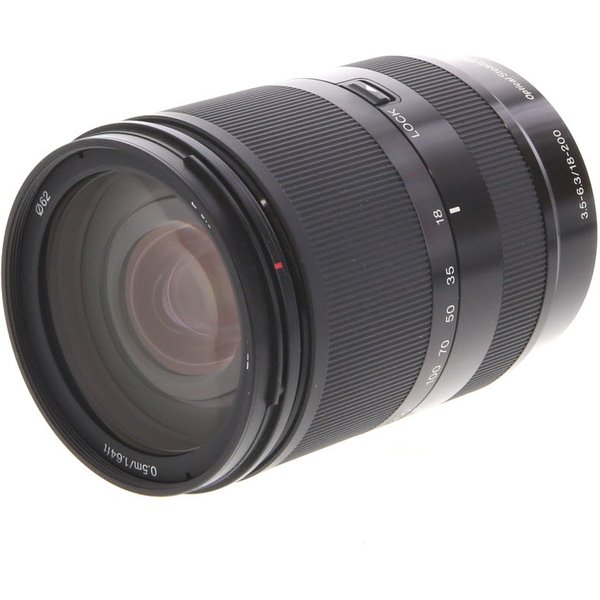
Sony E 18-200mm f/3.5-6.3 LE OSS Autofocus APS-C Lens
Prioritizes flexible framing or a practical everyday focal length.
View historical used-price research
Used-price context: 50 tracked observations since Jul 27, 2026. The lowest available used price across those snapshots ranged from $256 to $507. The latest tracked starting price is $161 lower than the first tracked snapshot.

Sony FE 200-600mm f/5.6-6.3 G OSS Full-Frame Autofocus Lens
Prioritizes longer telephoto reach for distant subjects.
View historical used-price research
Used-price context: 39 tracked observations since Jul 27, 2026. The lowest available used price across those snapshots ranged from $1,426 to $1,753. The latest tracked starting price is $327 lower than the first tracked snapshot.

Viltrox AF 33mm f/1.4 E STM ED IF APS-C Lens
Prioritizes lenses scored for available-light photography and brighter-aperture flexibility.
View historical used-price research
Used-price context: 12 tracked observations since Oct 23, 2026. The lowest available used price across those snapshots ranged from $169 to $169. The latest tracked starting price is unchanged from the first tracked snapshot.
What to check before purchasing
- Prioritize focal length and aperture for actual shooting constraints rather than treating lens cost as a quality ranking.
- For indoor children and events, compare a stabilized f/1.8 standard prime with the faster f/1.4 alternative; camera stabilization does not prevent subject motion.
- If you photograph small objects, compare true 1:1 macro reproduction and working distance rather than relying on the label close focus.
- Before paying more for a used a6500, inspect sensor condition, mount wear, rear-screen hinge, controls, card slot, stabilization operation and battery health.
- For video, account for body-era limitations, battery endurance, recording heat and lens focus noise; an expensive new lens cannot modernize the camera processor.
- On each used lens offer, confirm E-mount version, optical defects, included accessories, return window and total price.
Frequently asked questions
Choosing lenses for Sony a6500.
Can the Sony a6500 use full-frame FE lenses?
Yes. FE lenses use the Sony E mount and cover the APS-C sensor, but the a6500 retains its approximately 1.5x field-of-view crop.
Does the a6500 have in-body stabilization?
Yes, Sony specifies five-axis sensor-shift stabilization. It helps with camera shake but does not freeze moving subjects.
Which normal prime is worth comparing?
The Sony E 35mm f/1.8 OSS offers lens stabilization, while the Sigma 30mm f/1.4 DC DN provides a brighter maximum aperture and a slightly wider view.
Is a Sony E 30mm Macro a general low-light upgrade?
Not principally. Its key advantage is 1:1 macro reproduction; its f/3.5 aperture and very short working distance are different trade-offs from a fast portrait prime.