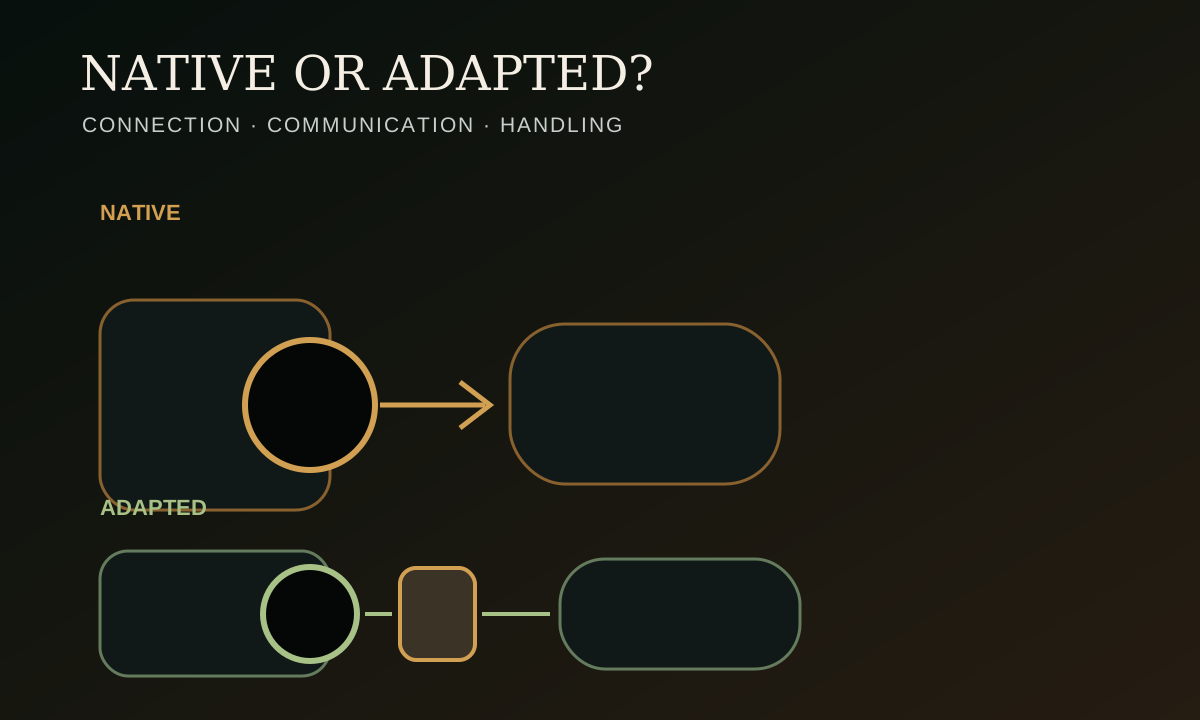
Mirrorless cameras can use an unusually broad range of older and cross-system lenses, but the presence of an adapter changes the compatibility question. The correct test is not whether the lens can be attached. It is whether the complete camera, adapter and lens combination supports the work you intend to do.
Why mirrorless cameras adapt older lenses so well
Mirrorless bodies place the lens mount closer to the sensor than most DSLRs. The missing mirror box creates physical space for an adapter to recreate the distance that an older DSLR or rangefinder lens expects. This is why many DSLR lenses can move forward onto a mirrorless body while the reverse conversion is usually impractical.
A simple mechanical adapter is essentially a precisely machined spacer with two mounts. An electronic adapter adds contacts, circuitry and firmware. A focal reducer adds optical elements that change field of view and light concentration. These products may all be called adapters, but they do different jobs and carry different risks.
Passive adapters are simple, but not automatically harmless
A passive adapter contains no electronic communication. The photographer focuses manually and controls aperture on the lens when the lens provides a physical aperture ring. This can work beautifully for landscapes, studio work, architecture, macro and deliberate video.
Precision still matters. If the adapter is too thick, too thin or slightly misaligned, the lens may fail to focus correctly or show uneven sharpness across the frame. Cheap adapters can also introduce rotational play, poor locking or internal reflections.
The best passive adapter is not necessarily the most elaborate one. It should hold the lens squarely, preserve infinity focus, release smoothly and avoid shiny internal surfaces.
Electronic adapters should be judged by the specific assignment
An electronic adapter may transmit autofocus, aperture, lens stabilization, metadata and focus-distance information. Marketing descriptions often summarize this as “full compatibility,” but performance can vary by lens and shooting mode.
Single autofocus on a stationary subject is the easiest test. Continuous autofocus, face and eye detection, high-speed bursts and video transitions are more demanding. A combination that performs well for portraits can remain unsuitable for sports or birds in flight.
Buyers should search for reports involving the exact camera, lens and adapter, not just the mount combination. Firmware generation matters. An adapter that worked well on an earlier body may need an update for a newer autofocus system.
Stabilization is one of the least understood adapter issues
A manual lens usually cannot report focal length to the camera. In-body stabilization may therefore require the photographer to enter the focal length manually. If the wrong value is entered, the body can apply the wrong correction.
Electronic adapters may pass focal-length and stabilization data, but the behavior is not universal. Some combinations use lens stabilization, some use body stabilization and some coordinate both. Video can reveal problems that are difficult to notice in still photography, including small jumps or unstable framing.
Adaptation can preserve value—or hide the real cost
Reusing lenses you already own is the strongest economic case for an adapter. The lens cost has already been paid, and one adapter may preserve an entire kit. Adaptation is also compelling when the lens provides a specialist capability that is unavailable or prohibitively expensive in the native system.
A new purchase requires a stricter calculation. Add the adapter, replacement caps, tripod foot, firmware dock and missing hood. Then compare the total with a used native lens. Include size, focus performance and resale value in the decision.
An adapted lens that is only slightly cheaper than a native alternative may be poor value. A distinctive macro, tilt-shift, cinema or vintage portrait lens can remain worthwhile even when the workflow is slower.
Browse electronic mirrorless lens adaptersVideo users need a different compatibility standard
Video places value on quiet focus motors, smooth aperture changes, controlled focus breathing and repeatable manual focus. A lens that is excellent for still photography may produce visible focus jumps, aperture stepping or stabilization movement in video.
Manual adapted lenses can be excellent for controlled filmmaking because they often provide tactile focus rings and predictable focus marks. Electronic adapted lenses are more complicated. Test focus transitions, subject detection, audio noise and stabilization before relying on the combination for important work.
Inspect a used adapter as carefully as a used lens
Both mounts should lock securely without excessive rotation. Contacts should be clean and level. The release mechanism should move smoothly. Removable tripod feet, filter holders and control rings should be included when the design uses them.
Check whether firmware tools remain available and whether the maker still supports the product. A discontinued adapter can continue working for years, but the lack of future updates should be reflected in the price.
Native-first results are the safest editorial policy
Mirrorless Lens World should not exclude adapted lenses. Doing so would ignore one of the major advantages of mirrorless systems. However, the site should rank native choices first and label adapted alternatives clearly.
That creates a safe default for beginners while preserving depth for experienced photographers. The site’s value lies in explaining the compromise, not in presenting every mechanically possible combination as equally suitable.
Mirrorless cameras can use many DSLR and manual-focus lenses, but adding an adapter creates another component in the compatibility chain.
What is a native lens?
A native lens attaches directly to the camera mount and is designed for its communication system. It normally provides the most predictable autofocus, aperture control, corrections and stabilization coordination.
What is an adapted lens?
An adapted lens uses a separate device between the camera and lens. Electronic adapters may transmit autofocus, aperture and metadata. Mechanical adapters generally provide only the correct physical spacing.
Advantages of adapted lenses
- Reuse an existing DSLR lens collection
- Access broader used inventory
- Use vintage and specialist optics
- Reduce the cost of changing systems
Potential disadvantages
- Slower or less reliable autofocus
- Reduced subject tracking performance
- More size and weight
- Additional firmware dependencies
- Manual stabilization configuration
Native lenses are usually better for
Sports, wildlife, weddings, event work, dependable continuous autofocus, video and compact travel kits generally benefit from native integration.
Adapted lenses can be excellent for
Landscapes, studio work, architecture, product photography, macro, controlled portraits and manual-focus video are often more tolerant of adapted operation.
Evaluate the complete combination
Compare the price of the lens and adapter together. Also consider balance, autofocus, aperture control, stabilization, minimum focus distance and total carrying weight.
The Mirrorless Lens World Lens Finder prioritizes native choices and can present adapted alternatives with compatibility notes.
Frequently asked questions
Common questions
Concise answers to compatibility, buying and practical-use questions readers commonly ask after reviewing the full guide.
What makes a lens native?
A native lens is designed to attach directly to the camera mount and communicate with that system without an adapter. Native lenses usually provide the most predictable autofocus, aperture, stabilization and correction behavior.
Do lens adapters reduce image quality?
A well-made passive adapter with no optical elements does not inherently reduce image quality. Poor alignment, incorrect thickness or internal reflections can still cause problems. Focal reducers and optical adapters require separate optical evaluation.
Will autofocus work with an adapted lens?
It may, but performance depends on the exact camera, lens, adapter and firmware. Single autofocus is easier to support than continuous tracking, high-speed bursts or video autofocus.
Can eye autofocus work with adapted lenses?
Sometimes. Eye detection may work on one camera and lens combination while remaining inconsistent on another. Confirm performance for the exact setup, especially when portraits or events depend on reliable tracking.
Does image stabilization work through an adapter?
It can, but support varies. Manual lenses may require the focal length to be entered in the camera menu. Electronic adapters may pass stabilization data, but lens and body stabilization do not always coordinate fully.
Are manufacturer adapters better than third-party adapters?
Manufacturer adapters usually provide the safest compatibility path for that company’s DSLR lenses. Third-party adapters can offer strong value or cross-brand support, but firmware history and model-level testing become more important.
Can mirrorless lenses be adapted to DSLRs?
Usually not in a practical way. Mirrorless lenses are designed for a shorter flange distance, and most DSLRs do not have enough physical space to recreate that geometry while preserving normal focus.
Are adapted lenses suitable for video?
Manual adapted lenses can be excellent for controlled video. Electronic adapted lenses should be tested for focus transitions, motor noise, aperture stepping, focus breathing and stabilization behavior.
When is a native lens worth paying more for?
A native lens is usually worth the premium when dependable tracking, high-speed bursts, video autofocus, compact handling or professional reliability matters more than the savings offered by adaptation.