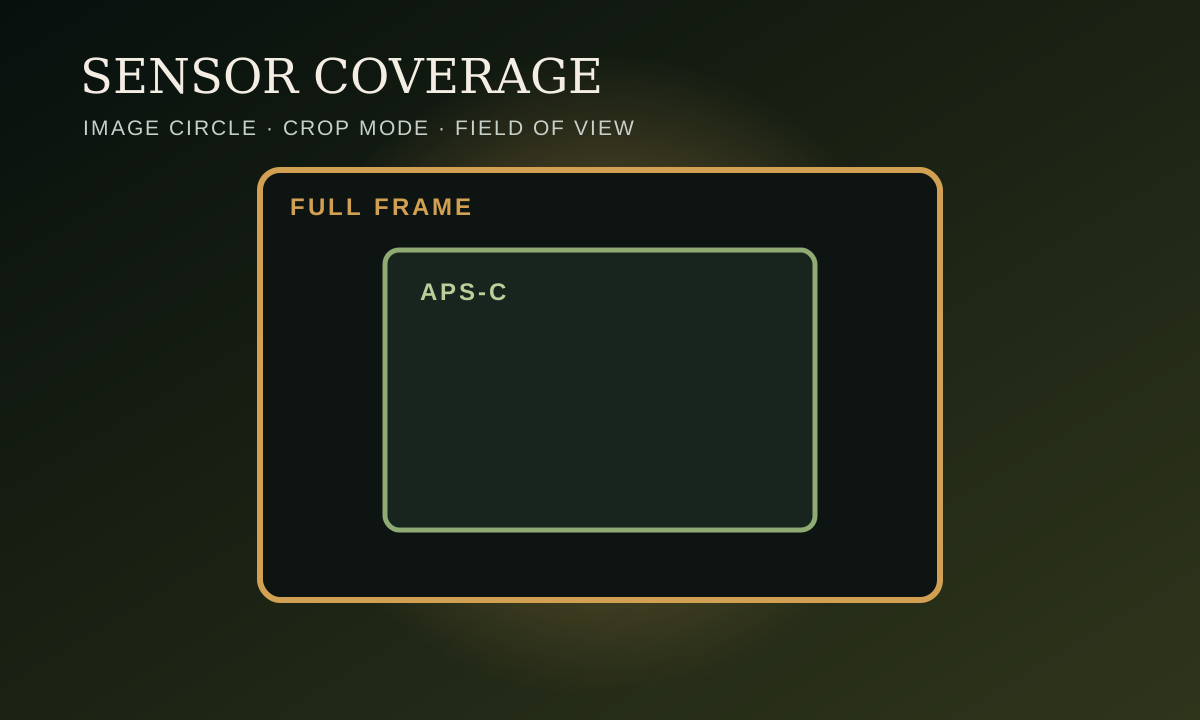
APS-C and full-frame labels describe the size of the image a lens is designed to cover. They do not always describe a different mount. That is why two lenses can attach to the same camera system yet produce different fields of view, crop behavior and long-term value.
The image circle explains the entire compatibility question
Every lens projects a circular image toward the sensor. A full-frame lens must project an image large enough to cover a full-frame sensor. An APS-C lens can use a smaller image circle because the sensor it is designed for is smaller. The smaller requirement can make an APS-C design lighter, less expensive or easier to optimize, although the result depends on the individual lens.
When a full-frame lens is mounted on a compatible APS-C body, the smaller sensor records the center of the image circle. Coverage is usually not a problem. The trade-off is that the camera captures a narrower field of view than the same lens would show on full frame.
When an APS-C lens is mounted on a compatible full-frame body, the camera may switch automatically to a cropped sensor area. If the camera allows the entire sensor to remain active, the image can show dark corners or a hard circular boundary. The physical mount may be correct while the recorded image still fails to use the complete sensor.
Crop factor changes framing, not the engraved focal length
A 35mm lens remains a 35mm lens on every compatible camera. Crop factor is a comparison of field of view. On a typical 1.5× APS-C body, a 35mm lens frames similarly to a 52.5mm lens on full frame. On a 1.6× body, it frames closer to 56mm. The focal length does not physically change; the smaller sensor records less of the projected scene.
This is most useful when translating familiar full-frame categories. A 16mm lens on 1.5× APS-C gives a field of view near 24mm equivalent. A 23mm lens behaves like a classic 35mm documentary lens. A 50mm lens becomes a short telephoto around 75mm equivalent, which can be attractive for portraits but restrictive as an everyday indoor lens.
The practical mistake is to copy a focal-length recommendation from one sensor format to another without translating the field of view. A popular 24mm full-frame lens does not provide the same wide composition on APS-C. A buyer who needs interiors or vlogging may require something closer to 15mm or 16mm on APS-C.
Crop mode has a real resolution cost
Full-frame cameras that support APS-C lenses often use only the central portion of the sensor. The resulting file contains fewer pixels than a full-sensor image. The exact output depends on the camera’s total resolution, but the principle is the same: a crop uses less sensor area.
That may be entirely acceptable for web publishing, social media, moderate prints or video modes that already use a cropped region. It is less attractive for photographers who crop aggressively, print large or bought a high-resolution body specifically to use the entire sensor.
Before treating an APS-C lens as a permanent full-frame solution, check the camera’s cropped image dimensions. A compact RF-S or DX lens can be useful on a full-frame body, but the convenience should be weighed against the reduced output.
Wide-angle photography exposes the biggest format difference
APS-C photographers gain a narrower field of view from every focal length, which can be useful for distant subjects but challenging for interiors, architecture, travel video and environmental portraits. A lens that begins at 24mm may feel versatile on full frame and relatively normal on APS-C.
This is why APS-C systems often offer zooms beginning near 10mm, 11mm, 12mm or 16mm. Those lenses are not unusually extreme for the smaller format; they are designed to recover familiar wide-angle views.
Compare wide-angle APS-C mirrorless lensesThe telephoto advantage is useful, but often overstated
APS-C framing can help wildlife, sports and aviation photographers fill more of the frame with a distant subject. A 300mm lens gives a field of view similar to roughly 450mm on a 1.5× body. That can make a smaller, lower-cost kit practical.
Crop factor does not add optical magnification or create extra detail by itself. Detail depends on pixel density, lens sharpness, focus accuracy, shutter speed, atmospheric conditions and subject distance. The narrower framing is real; the idea of “free reach” is incomplete.
A high-density APS-C sensor can place many pixels on a distant subject, while a high-resolution full-frame image may allow a similar crop after capture. The better choice depends on system size, autofocus performance, lens availability and budget.
Depth of field comparisons need equivalent framing
Statements such as “full frame has less depth of field” leave out the conditions of the comparison. If the same lens, aperture, focus distance and camera position are used, the optics do not change. What changes is framing. To create the same composition on different formats, the photographer usually changes focal length, distance or both.
In practical buying terms, full frame makes shallow-depth-of-field compositions easier at the same field of view and similar aperture. APS-C can provide more depth of field in a smaller, lighter kit. For macro, travel and event coverage, that can be an advantage rather than a limitation.
Should an APS-C owner buy full-frame lenses?
The answer depends on the focal length and the upgrade plan. A full-frame telephoto or portrait lens may remain useful on APS-C because the narrower framing suits the subject. A full-frame standard zoom may become too narrow at the wide end. Paying for a larger image circle is only sensible when the lens remains useful on the camera you own today.
Buy a full-frame lens for an APS-C body when it provides a capability the smaller system lacks, when a full-frame upgrade is genuinely planned, or when the current used price makes it competitive. Choose an APS-C-native lens when compactness, wide-angle coverage and value matter more than a hypothetical future body.
Use the Lens Finder to compare products by camera and sensor format, then review current used options in the lens catalog.
APS-C and full-frame labels describe sensor coverage, not necessarily the lens mount. That distinction explains why two lenses may attach to the same camera but behave differently.
What image coverage means
A lens projects a circular image toward the sensor. A full-frame lens creates an image circle large enough for a full-frame sensor. An APS-C lens can use a smaller image circle.
APS-C designs can therefore be smaller, lighter and less expensive, although the result depends on the individual lens.
Full-frame lenses on APS-C cameras
When the mount is compatible, an APS-C sensor normally records the central portion of a full-frame lens image. Advantages may include access to premium optics and an upgrade path to full frame.
The disadvantages can include greater cost, more weight and reduced wide-angle usefulness.
APS-C lenses on full-frame cameras
Some full-frame cameras automatically crop the image to the smaller area covered by the APS-C lens. This reduces the number of sensor pixels used.
Review the exact camera specification before purchasing. Do not assume that sharing a mount means the whole sensor will be used.
Crop factor and field of view
APS-C crop factors are commonly around 1.5× or 1.6×. A 35mm lens still has a physical focal length of 35mm, but its field of view resembles roughly 52mm to 56mm on full frame.
- 16mm on 1.5× APS-C: about 24mm equivalent
- 23mm: about 35mm equivalent
- 35mm: about 52.5mm equivalent
- 50mm: about 75mm equivalent
- 85mm: about 127.5mm equivalent
When an APS-C-native lens is better
- Compact size matters
- Wide-angle coverage is important
- You expect to remain with APS-C
- The native lens offers better value
When a full-frame lens makes sense
- You expect to upgrade to full frame
- The focal length suits APS-C framing
- The lens offers a unique capability
- The current used price is competitive
Browse the relevant lens system inventory and compare field of view, size and price before choosing based on sensor label alone.
Frequently asked questions
Common questions
Concise answers to compatibility, buying and practical-use questions readers commonly ask after reviewing the full guide.
Can I use a full-frame lens on an APS-C camera?
Usually yes when the lens and camera share a compatible mount. The smaller sensor records the central portion of the image circle, so coverage is normally not a problem. The field of view becomes narrower than it would be on full frame.
Can I use an APS-C lens on a full-frame camera?
Sometimes. Many full-frame cameras enter crop mode automatically, while other combinations can show strong vignetting or dark corners. Check the camera’s crop behavior and resulting image resolution before buying.
Does crop factor change the actual focal length?
No. A 35mm lens remains a 35mm lens. Crop factor describes the narrower field of view recorded by a smaller sensor compared with full frame.
How much resolution is lost in crop mode?
The answer depends on the camera’s sensor resolution and crop area. Because only the center of the sensor is used, the final file contains fewer pixels than a full-sensor image. Check the camera’s published crop-mode dimensions.
Why do APS-C cameras need shorter wide-angle lenses?
The smaller sensor records a narrower portion of the image. To obtain the same wide field of view used on full frame, APS-C cameras require a shorter actual focal length.
Does APS-C provide more telephoto reach?
APS-C provides narrower framing, which can help distant subjects fill more of the frame. It does not physically increase lens magnification. Recorded detail still depends on pixel density, focus accuracy, lens quality and shooting conditions.
Does full frame always produce shallower depth of field?
Not under every comparison. Depth of field depends on focal length, aperture, focus distance and framing. At equivalent framing and similar aperture, full frame generally makes shallower-depth-of-field compositions easier.
Should APS-C owners buy full-frame lenses for a future upgrade?
Only when the lens remains useful on the current APS-C body and a full-frame move is genuinely likely. Full-frame lenses can be larger, heavier and less useful at the wide end on APS-C.
Are APS-C lenses lower quality than full-frame lenses?
No. Sensor coverage does not determine quality. APS-C lenses can be optically excellent and may provide better size, weight and value for photographers committed to the format.