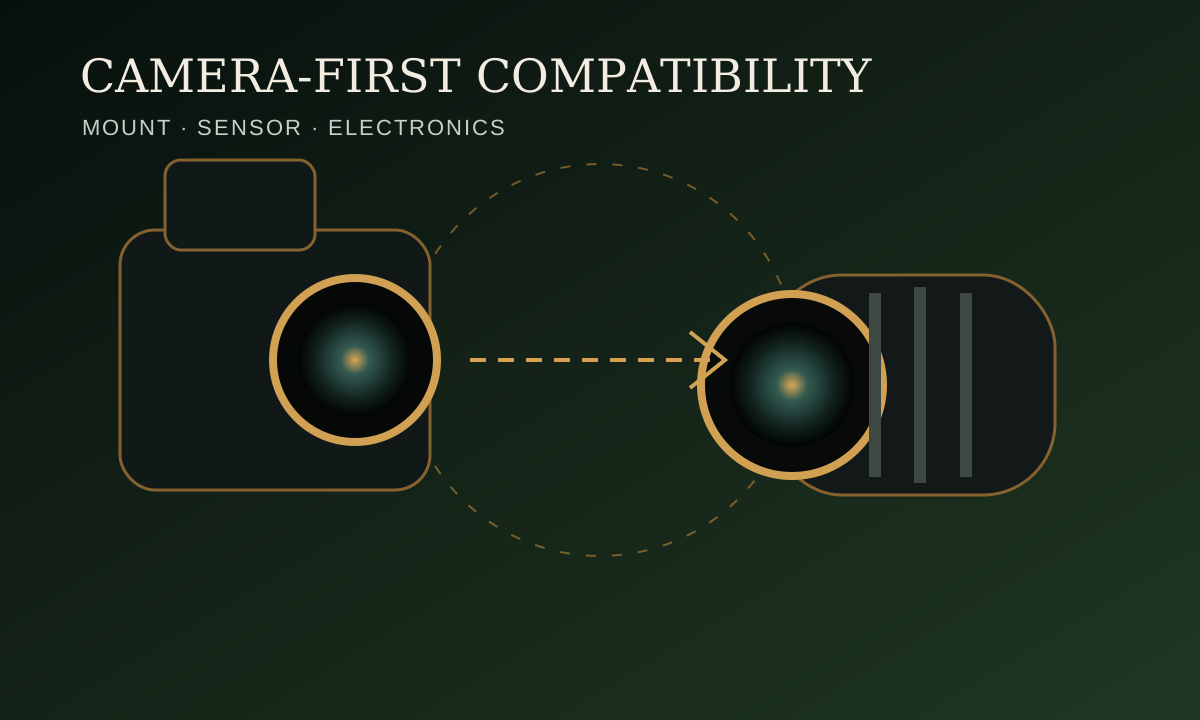
The safest way to buy a lens is to begin with the camera, not with the retailer listing. A lens can share the same brand name, appear to have the right diameter and still be wrong for the camera because the mount, sensor coverage or electronic support does not match.
Compatibility is a chain, not a yes-or-no label
Shoppers often ask whether a lens “fits” a camera as though there is only one test. In practice, compatibility is a chain of decisions. The lens must attach mechanically, project an image large enough for the sensor and communicate with the camera well enough for the intended work. Every link in that chain matters.
Mechanical compatibility is the first gate. The mount determines the locking surfaces, flange distance and position of the electrical contacts. Canon RF, Canon EF and Canon EF-M are not interchangeable simply because they are Canon products. Nikon Z and Nikon F are different systems. Fujifilm X and Fujifilm G are designed for different sensor formats and camera families. Sony E is shared by full-frame and APS-C bodies, but that does not mean every E-mount lens covers every E-mount sensor in the same way.
Sensor coverage is the second gate. A lens designed for a smaller sensor may attach to a larger-format camera but force the camera into crop mode or leave dark corners around the image. The third gate is electronic behavior: autofocus, aperture operation, stabilization, lens corrections, metadata and video communication. A combination that is acceptable for a manually focused landscape can still be a poor choice for birds, sports or event work.
Start by identifying the exact camera, not just the brand
The complete camera model is the most useful starting point because it tells you which mount, sensor and feature generation you are working with. “Sony mirrorless,” “Canon EOS” or “Nikon camera” is not enough. A Sony a6400, Sony a7 IV and Sony a9 III all use E-mount, but their sensor sizes, performance expectations and sensible lens choices differ. A Canon EOS R50 and EOS R6 Mark II share the RF mount, yet an RF-S lens has different consequences on each body.
Record the model name exactly as it appears on the camera. Then confirm the mount and sensor format in the manufacturer specification or the Mirrorless Lens World camera guide index. Once the camera profile is established, the Lens Finder should narrow the catalog before you compare prices.
Read the complete lens name as a technical description
Lens names are dense because they often encode the information a buyer needs. The focal length describes the angle of view. The maximum aperture indicates how much light the lens can admit at its widest setting. Mount abbreviations identify the camera family. Other labels may signal stabilization, autofocus motors, sensor coverage or a professional product tier.
The difficult part is that abbreviations differ by manufacturer. Sony uses FE for full-frame E-mount lenses and E for many APS-C products. Nikon uses Z for the mirrorless mount and DX for many APS-C-oriented lenses. Canon uses RF and RF-S. Fujifilm X-mount lenses are designed around the APS-C X system, while GF lenses belong to the medium-format GFX system. Micro Four Thirds lenses may carry Olympus, OM System, Panasonic or third-party branding while sharing the same mount standard.
A retailer title can omit, shorten or misplace those identifiers. The manufacturer model number is therefore the strongest cross-check. When the title, specification and product photograph do not agree, do not assume the listing is correct.
Native lenses offer the cleanest compatibility path
A native lens is built for the camera mount and communication protocol. Native does not automatically mean sharper, more expensive or better for every photograph. It means the manufacturer designed the lens to work directly with the system.
That direct relationship matters most when the camera is expected to track moving subjects, coordinate stabilization, apply lens corrections or perform smoothly in video. Native lenses usually provide the most predictable autofocus modes, aperture control, focus-distance reporting and firmware behavior. They also tend to preserve the compact balance that makes mirrorless systems appealing.
An adapted lens can still be the right choice when it preserves an existing DSLR kit, provides access to a specialist optic or creates a substantial price advantage. The key is to label the choice accurately. Mirrorless Lens World should present adapted options as deliberate alternatives, not mix them silently with native results.
Browse mirrorless lens-mount adaptersThird-party lenses require one more verification step
Sigma, Tamron, Samyang, Viltrox, Laowa and other manufacturers often sell related lenses for several mounts. Two versions can look nearly identical and share the same focal length, aperture and marketing name. The mount designation and part number are what separate them.
Electronic third-party lenses may also depend on firmware. A lens released before a newer camera body can require an update to improve autofocus, correct metadata or restore compatibility with newer subject-detection modes. This does not make third-party lenses unsafe; it means the buyer should treat firmware history as part of the product specification.
For used purchases, check whether the lens can be updated directly through the camera, through a USB port, through a dock or only by a service center. A low-priced lens that cannot be updated may be a poor value for a newer camera.
Common listing mistakes that should stop the purchase
Retailer and marketplace listings are created from feeds, seller templates and copied product descriptions. Most are accurate, but compatibility mistakes are common enough that the buyer should know what to look for.
Stop and verify the listing when the mount is absent, the seller identifies only a brand, the sensor format is unclear, an adapter is shown but not included, or the photograph displays a different mount variant. Phrases such as “fits Nikon,” “for Canon digital cameras” or “works with Sony mirrorless” are too broad to support a purchase.
The return policy is important, but it should not substitute for compatibility research. Returning an incorrect lens costs time and can create restocking or shipping expenses. Camera-first filtering is a more efficient safeguard.
A practical compatibility workflow
Begin with the camera model and identify the native mount. Determine whether the body is full frame, APS-C or Micro Four Thirds. Choose the subject and the field of view needed for that subject. Decide whether adapted lenses are acceptable. Only then should you compare lens families, current offers and condition grades.
This order matters because it reflects the purpose of Mirrorless Lens World. The site is not simply a storefront for every lens that appears in a feed. It is a compatibility and market-intelligence layer that helps the photographer reach a smaller, safer set of choices before leaving for a retailer.
Continue with the focal-length guide when the mount is known but the ideal lens type is not, or compare current compatible products in the live lens catalog.
Lens compatibility is more than matching a brand name. A lens may physically attach and still produce a crop, require an adapter or lose important electronic functions.
Begin with the exact camera model
Start by identifying the complete camera model. Sony, Canon, Nikon and Fujifilm have each produced cameras using more than one lens mount. The model name lets you determine both the mount and sensor format.
Use the camera guide index or enter the model into the Lens Finder before comparing listings.
Confirm the lens mount
The mount is the mechanical and electronic connection between the lens and camera. Current mirrorless systems include Sony E, Canon RF, Nikon Z, Fujifilm X, Micro Four Thirds and L-Mount.
Similar-looking mounts are not interchangeable. Never force a lens onto a camera because the openings appear close in size.
Check sensor coverage
Mount compatibility answers whether the lens attaches. Sensor coverage answers whether its projected image is large enough for the camera sensor.
A full-frame lens generally covers an APS-C sensor when both use the same mount. An APS-C lens on a full-frame camera may trigger crop mode or produce dark corners.
Native and adapted operation
Native lenses are designed for the camera mount and normally provide the most predictable autofocus, aperture control, lens corrections and stabilization behavior.
Adapted lenses can be excellent, but compatibility should be checked for the exact camera, lens and adapter. Review autofocus, continuous tracking, aperture control, stabilization and video behavior.
Compatibility checklist
- Exact camera model
- Camera mount
- Camera sensor format
- Lens mount
- Lens sensor coverage
- Native or adapted connection
- Autofocus and aperture support
- Stabilization behavior
- Crop-mode consequences
Compare compatible inventory
Once compatibility is established, use the live lens catalog to compare product families, current offers and condition grades without sorting through duplicate listings.
Frequently asked questions
Common questions
Concise answers to compatibility, buying and practical-use questions readers commonly ask after reviewing the full guide.
How do I identify the lens mount used by my camera?
Use the exact camera model rather than the brand name alone. Check the manufacturer specification, camera manual or Mirrorless Lens World camera guide. Manufacturers often operate several incompatible mounts, so a broad description such as “Canon mirrorless” or “Nikon camera” is not precise enough.
Can two cameras from the same manufacturer use different lens mounts?
Yes. Canon has used EF, EF-S, EF-M, RF and RF-S systems; Nikon has F and Z; Fujifilm has X and G; and several manufacturers have discontinued legacy mounts. Always verify the exact camera model and mount before purchasing.
Can a lens physically attach but still be incompatible?
Yes. Physical attachment does not guarantee complete sensor coverage, autofocus, aperture control, stabilization communication, lens corrections or firmware support. Compatibility should be evaluated mechanically, optically and electronically.
What happens when an APS-C lens is used on a full-frame camera?
Many full-frame cameras switch to an APS-C crop mode and use only the center of the sensor. Other combinations may show dark corners or heavy vignetting. The resulting file usually has fewer pixels than a full-sensor image.
Can DSLR lenses be used on mirrorless cameras?
Many DSLR lenses can be used through the correct adapter because mirrorless bodies have a shorter flange distance. Performance depends on the exact camera, lens and adapter, especially for autofocus, stabilization, burst shooting and video.
Will autofocus work through a lens adapter?
It may, but support varies. Single autofocus can work well while continuous autofocus, eye detection, subject tracking or video transitions remain limited. Check the exact combination rather than relying on a general claim that the adapter supports autofocus.
Do third-party lenses work as well as manufacturer lenses?
Many third-party lenses work very well, but the mount version and firmware must be correct. Confirm the manufacturer part number and check whether the lens supports the camera’s autofocus modes, corrections and firmware update process.
Can firmware affect lens compatibility?
Yes. Firmware can improve autofocus, metadata, stabilization coordination and compatibility with newer camera bodies. This is particularly important for electronic third-party lenses and adapters.
What information should I verify in a used-lens listing?
Confirm the complete lens model, mount, sensor coverage, included accessories, firmware status, autofocus support and return policy. Be cautious when the title, specification and product photograph do not describe the same mount version.
What is the safest way to search for compatible lenses?
Start with the exact camera model, then filter by native mount and sensor format before comparing focal length, price and condition. This camera-first sequence is safer than opening retailer listings and trying to determine compatibility afterward.